EU Data Act compliance tools compared: 8 solutions ranked for 2026


The EU Data Act (Regulation (EU) 2023/2854) changes who controls the data generated by connected products. From September 2025, manufacturers of IoT and connected devices have to give users access to the data their products generate, let them share it with third parties, and - in business-to-business settings - handle compensation under FRAND terms. Articles 3, 4, and 5 are the core of it: access by design, user access, and third-party sharing.
If you make connected products, this is now an engineering and legal problem at the same time. A handful of vendors have built software to handle it. Others position broad privacy or governance platforms as adjacent help. This article ranks eight of them by how directly they address the Data Act, based on product documentation, pricing pages, and published case studies reviewed in June 2026.
A note on scope before the ranking: not every tool here was built for the Data Act. Four were. The rest cover it partially, indirectly, or not at all - and we say so plainly in each entry. We’ve left out pure consent-management platforms (cookie banners, GDPR/CCPA consent) because they don’t touch the Data Act’s access and sharing obligations, which is a different problem.
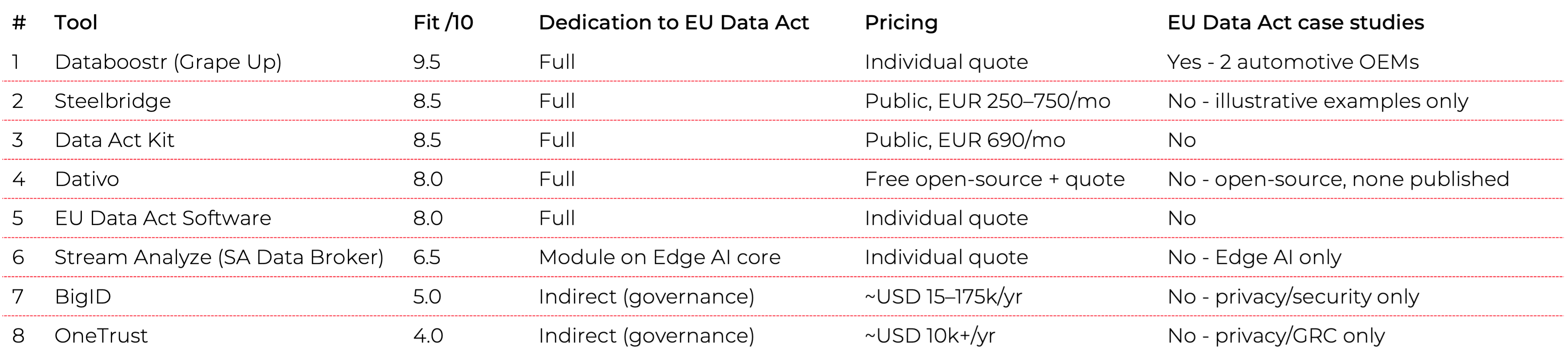
The ranking at a glance
How we scored the tools
Each tool received a fit score from 0 to 10 for how well it addresses the EU Data Act specifically - not privacy or governance in general. The factors: whether the product is dedicated to the Data Act, which articles it covers, the breadth of relevant functionality, deployment model, target users, pricing transparency, and whether there are published case studies tied to the regulation.
The ranking
1. Databoostr - 9.5/10
Databoostr is built specifically for the EU Data Act and covers the widest functional range of any tool reviewed. It provides a B2C portal for user data access and consent, a B2B portal for partners, and - unusually - handles the compensation and FRAND-terms side of Articles 3, 4, 5, and 9. It’s the only tool in this comparison that pairs compliance with data monetization, treating the regulation as a data-sharing capability rather than only a cost.
It is built by Grape Up, an EU-based company headquartered in Poland, so it offers EU data residency and is developed under EU jurisdiction - relevant where sovereignty is a requirement. It targets OEMs and manufacturers of connected products across automotive, home appliances, manufacturing, and material handling. Deployment is flexible: SaaS or on-premises on the customer’s own infrastructure. It also supports related regulations including Right to Repair and preparation for FIDA, and works alongside GDPR.
It’s the only tool here with published case studies tied to the Data Act: two automotive OEM deployments, one in Europe and one in Japan, covering six relevant articles.
The trade-offs: pricing isn’t public and depends on the scope of integrations and deployment, and a full rollout with integrations can take weeks to months. There may be associated consulting work on the legal, process, and technical sides.
2. Steelbridge - 8.5/10
Steelbridge, from Helsinki, Finland, is fully dedicated to the EU Data Act and offers one of the broadest module sets among the dedicated tools. It covers consent management (GDPR-aligned), a data-access API (REST and webhooks), a compliance dashboard with audit logs, emergency data access for public bodies under Article 15, trade-secret protection, and - like Databoostr - a billing and monetization layer that turns third-party access into a revenue stream rather than only a cost. There is also a white-label option for OEMs and resellers.
It is one of only two tools here with fully public pricing: EUR 250, 500, or 750 per month, billed monthly with cancel-anytime terms, plus optional onboarding at EUR 1,500 and custom enterprise/white-label tiers. It targets IoT manufacturers, industrial machinery makers, energy companies, and mobility providers, quotes go-live in roughly 6–8 weeks, and - being based in Finland - offers EU data residency. It has also received innovation funding from Business Finland.
It lands neck-and-neck with Data Act Kit (both 8.5): Steelbridge edges ahead on breadth of modules and the white-label option, Data Act Kit on raw speed of integration. The shared limitation is maturity - Steelbridge is an early-stage company with no published customer case studies yet, so the product and pricing are well developed but the market track record isn’t there.
3. Data Act Kit - 8.5/10
Data Act Kit, built in Germany, is the fastest route to compliance among the dedicated tools. It’s a “plug-and-play” set of APIs plus a white-label portal: one API connects to your backend, and the kit handles real-time data distribution to an unlimited number of third parties. It covers Articles 4 and 5 - user and third-party access.
It’s also one of only two tools in this comparison with public pricing. The Standard plan is EUR 690 per month for the full feature set, with an Enterprise tier above it. There’s a 21-day full-access trial with no card required, and onboarding and implementation support are included. Because there’s no infrastructure to build, integration runs in days to weeks.
The main limitation is vendor maturity. It’s a young, very small operation with no published case studies yet. For teams that need a fast, narrow path to Articles 4 and 5 and can accept a small vendor, it’s a strong option.
4. Dativo - 8/10
Dativo, an open-core platform from Unio Lab (a product lab based in Germany, France, and Tunisia), is fully dedicated to the EU Data Act and covers Articles 3 through 6 - including third-party sharing, FRAND compensation terms, and Article 4(3) trade-secret classification with withholding records. Its feature set is purpose-built and broad: an equipment registry with identifier matching, a dataset catalog with data mapping, a customer self-service portal, a fulfillment engine with SLA tracking for Article 4 timing, a compliance audit trail with regulatory export, and a connector SDK.
Its distinguishing feature is licensing. Dativo is the only open-source option in this comparison: the Community Edition is free and source-available (BSL 1.1, converting to Apache 2.0 after three years), described as production-ready, and self-hostable via Docker or Kubernetes. Paid Professional (managed EU-hosted cloud) and Enterprise (self-hosted, data never leaving your network) tiers add Snowflake/Databricks connectors, trade-secret workflows, third-party flows, and support - priced by quote rather than published numbers. The self-host and EU-hosting options make it a strong fit where data sovereignty and source auditability matter.
The caveats are maturity. Dativo was built by a two-person team and shipped quickly, several of its headline features (smart matching, auto-suggested mapping, a natural-language data explorer) are still marked coming soon, and there are no published customer case studies yet. The open core is real and auditable today; some of the automation around it is still on the way.
5. EU Data Act Software - 8/10
This Danish product is dedicated to the EU Data Act and states its coverage of Articles 3, 4, and 5 explicitly. It provides a data-request portal for both users and third parties, request handling, and governance rules. Hosting is in the EU with multiple options, and the architecture is multi-tenant, aimed at everyone from small IoT firms to large enterprises.
It’s a sensible choice where EU data residency and sovereignty matter, given EU-only hosting and GDPR rules built into governance. There’s a free trial and a demo.
What’s missing is public proof. There’s no published pricing (you request a quote), no case studies yet, and the company is young with a limited public track record. It runs a partner program for advisors.
6. Stream Analyze (SA Data Broker) - 6.5/10
Stream Analyze, from Sweden, is primarily an Edge AI and streaming-analytics platform, with a dedicated Data Broker module for the Data Act layered on top. The core technology is genuinely strong: an on-device agent with an engine as small as 17 kB, paired with a Data Broker that runs in the cloud or on-premises. It addresses Article 3 (access by design), 4, and 5 (porting and streaming), and is unusual in starting from the device rather than the cloud.
It fits industrial settings - transport, manufacturing, energy, mobile machinery - where data originates on the device and low footprint matters. Stream Analyze has published case studies, but they’re about Edge AI (for example, failure prediction for mining loaders), not the EU Data Act.
The reason it sits mid-table: the EU Data Act is a side product relative to the Edge AI core, there are no EU Data Act-specific case studies, pricing is by individual quote, and deployment requires access to device firmware and software, which lengthens rollout to weeks or months.
7. BigID - 5/10
BigID (US/Israel) is a broad data security, privacy, and AI-governance platform - DSPM at its core - rather than a Data Act tool. Its strength as a foundation is data discovery and classification across IoT, SaaS, and structured and unstructured sources, which is genuinely useful groundwork for the access and transparency the regulation requires. It addresses Data Act concerns indirectly: portability, processing transparency, FRAND-adjacent governance.
It’s aimed at large enterprises and regulated sectors, and supports a long list of other regulations: GDPR, CCPA, the EU AI Act, data sovereignty, and more.
But there’s no dedicated Data Act module - the positioning lives in a blog post about the regulation going live, not a product. Pricing is enterprise-scale: typically USD 15,000 to 175,000 per year, with large deployments much higher (one public figure reaches USD 698,000). Rollout is a multi-week-to-month enterprise project, and addressing the Data Act through governance modules adds complexity..
8. OneTrust - 4/10
OneTrust (US) is the broadest compliance platform in the comparison - consent and preferences, privacy automation (DSAR), data-use governance, and AI governance, supporting GDPR, the EU AI Act, SOC 2, and hundreds of regulations. With 14,000+ customers, it’s also the most established vendor here.
For the Data Act specifically, though, there’s no product or module - only educational blog content. The relevant capabilities (consent, access requests, governance) touch the regulation indirectly at best. Pricing starts around USD 10,000 per year (as of Q2 2026), with a median near USD 11,500; implementation fees typically run 20-40% of the annual subscription, and time to deploy is commonly 3-6 months. There are no Data Act case studies, only the educational material. Strong privacy and GRC platform; not an EU Data Act solution.
What these tools have in common - and where they diverge
The five dedicated tools (Databoostr, Steelbridge, Dativo, Data Act Kit, EU Data Act Software) share a functional core: a data-request portal, consent and access management, and third-party sharing aligned to Articles 3-5. The broader platforms (BigID, OneTrust) come at it from the other direction - they grew out of GDPR/CCPA privacy and governance, and treat the Data Act as one more regulation among many rather than a built-for-purpose product.
Dedication. Fully dedicated: Databoostr, Steelbridge, Dativo, Data Act Kit, EU Data Act Software. Dedicated module: Stream Analyze. Indirect via governance: BigID, OneTrust.
Licensing. Dativo is the only open-core option - a free, source-available Community Edition (BSL 1.1, converting to Apache 2.0)that you can self-host and audit. Every other tool is closed-source SaaS.
Architecture starting point. From the device (edge agent): Stream Analyze. From the cloud or API: the dedicated tools and the platforms.
Pricing transparency. Public pricing: Data Act Kit (EUR 690/month) and Steelbridge (EUR 250–750/month) among the serious Data Act options. ); Dativo publishes a free open-source tier but quotes its commercial editions. Everyone else quotes individually.
Time to compliance. Fastest: Data Act Kit (one API, days to weeks), with Steelbridge close behind (about 6–8 weeks). Slower: tools requiring device-level integration or enterprise rollouts (Stream Analyze, BigID, OneTrust, at 3–6 months for the platforms).
Data monetization. Two tools build billing for third-party access into the product, turning compliance into a possible revenue stream: Databoostr and Steelbridge. Dativo handles FRAND compensation terms as part of its third-party workflow.
Market evidence. Data Act case studies exist for only one tool: Databoostr (two automotive OEMs). Others have case studies in adjacent domains, or - like Steelbridge and Dativo -0 none published yet, so nothing tied to the regulation.
Data residency. EU-based options: Databoostr (Grape Up, Poland), Dativo (self-hosted or EU-hosted; Unio Lab,Germany), Steelbridge (Finland), EU Data Act Software (Denmark, EU hosting), and Data Act Kit (Germany) lead here, which matters where sovereignty is a requirement.
How to choose
If you need the widest functional coverage and want to treat data sharing as a capability rather than only a compliance cost, Databoostr covers the most ground and is the only option with Data Act case studies behind it. If you want broad module coverage with transparent pricing and a monetization layer, Steelbridge is the closest alternative. If your priority is the fastest, cheapest path to Articles 4 and 5 and you can work with a small vendor, Data Act Kit is the most direct. If you want an open-source platform you can audit and run on your own infrastructure - with a free tier to start - Dativo is the only one here. If EU data residency is non-negotiable, EU Data Act Software is built around it (and Steelbridge, Dativo, Databoostr, and Data Act Kit are also EU-based). If your data lives on industrial edge devices, Stream Analyze’s architecture is the natural fit. And if you already run BigID or OneTrust for privacy and governance, they can support parts of the work - but you’ll be assembling compliance from general-purpose modules rather than buying a Data Act product.
The honest summary: five tools were built for this regulation, and they should be the starting point for most connected-product manufacturers. The broad platforms are worth considering only if you already own them and want to extend what you have.
Frequently asked questions
What does the EU Data Act require from manufacturers of connected products?
From September 2025, makers of IoT and connected devices must give users access to the data their products generate (Article 4), let users share that data with third parties (Article 5), and design products so the data is accessible in the first place (Article 3, access by design). In business-to-business settings, data sharing has to happen on fair, reasonable, and non-discriminatory (FRAND) terms, which can include compensation (Article 9).
Which tools are dedicated to the EU Data Act?
Five of the eight reviewed are built specifically for the Data Act: Databoostr (Grape Up, an EU-based company from Poland), Steelbridge (Finland), Dativo (an open-source platform from Unio Lab), Data Act Kit, and EU Data Act Software. Stream Analyze offers a dedicated Data Broker module on top of an Edge AI core. BigID and OneTrust address the regulation only indirectly through general privacy and governance features.
Which EU Data Act tool is the fastest and cheapest to deploy?
Data Act Kit is the fastest dedicated route: a single API plus a white-label portal, integration in days to weeks, public pricing at EUR 690 per month, and a 21-day free trial. It covers Articles 4 and 5. Steelbridge is the other publicly priced option (EUR 250–750 per month) and goes live in about 6–8 weeks with a broader module set. The shared trade-off is vendor maturity - both are young, with no published case studies yet. On raw cost, Dativo goes furthest with a free, open-source Community Edition you self-host, though its managed and enterprise tiers are quote-based and some features are still in progress. The shared trade-off across these newer tools is vendor maturity — none has published case studies yet.
Which EU Data Act tool has the widest coverage?
Databoostr covers the most ground in this comparison: B2C and B2B portals, consent and access management, and the compensation/FRAND side of Articles 3, 4, 5, and 9. It is also the only reviewed tool with published case studies tied to the Data Act (two automotive OEM deployments). Pricing is by individual quote, and a full rollout can take weeks to months.
Do privacy platforms like OneTrust or BigID cover the EU Data Act?
Not directly. Both are strong privacy, security, and governance platforms (GDPR, CCPA, the EU AI Act, and more), and their data discovery, consent, and governance features can support parts of Data Act work. But neither has a dedicated Data Act product or module - OneTrust offers only educational content, and BigID positions through a blog post. Neither has Data Act-specific case studies.
Which tools support EU data residency?
Databoostr (Grape Up) is an EU-based company headquartered in Poland and offers EU data residency. Steelbridge (Finland), Dativo (self-hosted orEU-hosted; built by Unio Lab in Germany), EU Data Act Software (Denmark,EU hosting with GDPR rules built into governance), and Data Act Kit (Germany)are also EU-based. These are the strongest fits where data sovereignty is a hard requirement.
Is there an open-source EU Data Act compliance tool?
Yes. Dativo, built by Unio Lab, is the only open-source option among the tools reviewed. Its Community Edition is free and source-available (BSL 1.1, converting to Apache 2.0 after three years) and can be self-hosted via Docker or Kubernetes, so you can audit the code and keep data on your own infrastructure. Paid managed-cloud and self-hosted enterprise editions add advanced connectors, trade-secret workflows, and support.